Engineering Advantages and the Maintenance Practices That Protect Them.
By Dennis Blauser
For an industry where every square foot of a facility’s real estate and every ton of usable capacity directly affect the bottom line, it is crucial to consider the engineering advantages of different bulk storage structures.
Traditional concrete storage silos, constructed via Jumpform or Slipform methods, remain the workhorse of the industry. They offer exceptional structural durability, a compact ground footprint, and lower lifetime maintenance costs than steel alternatives. However, as facilities scale up total storage requirements to meet rising production demands, storage domes become an increasingly attractive alternative.
When evaluating new bulk storage, total footprint and volume drive the decision. The geometry of storage domes allows a single structure to hold significantly more material than a conventional silo of similar footprint and height. However, the way material moves through the two structures is significantly different.
Traditional silos rely primarily on gravity to move material downward toward the discharge point, while domes often require material to move horizontally across the floor toward the center discharge. This less direct flow path makes domes more susceptible to poor material flow and compaction, which can make complete material reclamation more difficult.
While this can be a huge benefit to certain facilities, it is important to understand that dome aeration systems, reclaim equipment, and the interior shell itself are all subject to the same material buildup, corrosion and wear that affect any bulk storage structure. Furthermore, a dome’s shape can make some of those problems harder to diagnose and reach than they would be in a conventional silo.
Therefore, a dome’s structural and volumetric efficiency only pays off if the internal material handling system functions as designed. That means that, like traditional silos, concrete storage domes still require essential maintenance. Understanding both sides of that equation, the engineering advantages of dome storage and the operational realities of keeping one running are essential for any cement producer weighing a dome investment or managing one already in service.
Where Dome Systems Run Into Trouble
The same qualities that make dome storage efficient also make it demanding to maintain. Cement is hygroscopic and compacts readily under its own weight, so any moisture that reaches the interior, whether through a compromised roof coating, a poorly sealed penetration, or condensation inside an inadequately insulated shell, can trigger localized hydration. Once cement begins to harden against a dome wall or across an aerated floor, it does not resolve on its own, and it can progress from a minor flow restriction to a structural concern if it is left unaddressed.
Because reclaim and fluidizing systems in a dome are typically built into the floor and lower walls, rather than concentrated at a single discharge point, buildup does not always announce itself the way it might in a conventional silo. Facility teams often notice a problem only once it begins to affect production.
Material blowing out of aeration pipes, uneven or restricted material flow, and a gradual decline in a dome’s effective working capacity are among the most common warning signs, and each typically points back to hardened material somewhere in the aeration or discharge system rather than a single, easily located blockage. Keeping those specific components clean and functional is what prevents a high-capacity dome from becoming a massive operational liability.
Case Study: Diagnosing and Restoring a High-Capacity Cement Dome
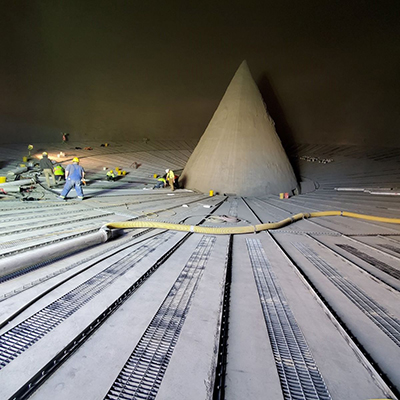
A recent USA Silo Service project illustrates how those warning signs come together in the field. A cement producer operating a 125-ft.-tall, 180-ft.-diameter storage dome on the West Coast, built around an interior inverted concrete cone housing the unloading equipment, began noticing material blowing out of the aeration pipes surrounding the dome along with a steady decline in material flow and overall utilization efficiency. The customer contacted USA Silo Service to inspect the structure, clean it and recommend corrective action.
Inspection revealed hardened, compacted material buildup distributed throughout the dome structure. Because of the dome’s unique shell geometry, crews utilized specialized equipment to break up severe wall formations into manageable pieces. Once the material was dislodged, USA Silo Service provided integrated, high-capacity vacuum truck services directly on site to extract and dispose of the material cleanly, recovering approximately 600 net tons of cement without disrupting surrounding plant traffic. Providing seamless material extraction alongside specialized cleaning ensures facilities receive a complete, turn-key cleanout solution without needing to coordinate third-party vacuum contractors.
The inspection also identified the underlying cause behind the aeration problems the customer had reported. With the air pads, fasteners and grating removed for cleaning access, the crew found considerable corrosion on the fasteners, which had allowed material to build up inside the airways and troughs beneath the dome floor, restricting the airflow the fluidizing system depends on. USA Silo Service cleaned the affected airways and troughs and replaced the failed fasteners and grating along with the air pad filter cloth before returning the dome to service.
Following project completion, the client’s senior project engineer remarked that the dome had never performed as well, even when it was new.
The project underscores a pattern common to dome storage: the visible symptom, in this case material escaping from aeration pipes, was a downstream effect of a maintenance issue below the surface. Diagnosing it required opening up the fluidizing system itself rather than treating the aeration pipes as the problem.
Best Practices for Dome Cleaning, Inspection and Maintenance
Regular cleaning removes buildup before it can restrict flow, recovers material that would otherwise be lost inside the structure, and reduces the risk of the kind of compounding damage seen when corroded fasteners are left in place under a dome floor. For dome structures specifically, an effective maintenance program generally includes the following elements.
Scheduled interior cleaning. Professional cleaning services use remote and specialized techniques suited to a dome’s curved geometry to remove hardened material from the interior shell and restore uniform material discharge, rather than waiting for flow problems to force an emergency response.
Fluidizing equipment inspection. Air pads, fasteners, and the grating and airways beneath a dome floor should be inspected on a regular basis rather than only when a flow problem appears. Worn or corroded components can allow buildup to progress out of sight for an extended period before it produces a visible symptom such as material escaping from aeration piping.
Advanced inspection and structural integrity. Periodic professional inspections give facilities the critical data needed to schedule cleaning, coating and repair work before minor deficiencies cause unplanned downtime. Utilizing modern diagnostic tools, such as an AI-enhance inspection service, can provide faster, more accurate exterior inspection. AI-enhanced inspection combines drone capture technology with advanced software to process images and video into an interactive 3D model, where AI identifies defects, maps their exact location, and ranks them by severity. USA Silo Service’s sister company is a leading provider of AI-enhanced inspection services, who is then able to use that inspection data with their extensive engineering and restoration capabilities to provide restoration or repair services before a problem becomes an emergency.
Qualified Labor and Safety Standards.
While storage domes do not present the exact same vertical confined space hazards or wall bridging dynamics as traditional silos, interior cleaning still carries significant operational risks. Cement compacts heavily and creates massive, unstable overhangs along curved dome shells that can suddenly shift during cleanout operations.
Sending untrained internal plant personnel into a dome to clear hardened material manually introduces severe risk of injury, along with potential structural damage if buildup is disturbed incorrectly. Cleaning and inspection should always be conducted by specialized crews trained to OSHA and MSHA standards, equipped with the specific rigging, safety gear and specialized equipment required to handle dome cleaning safely.
Provider Selection.
Because dome cleaning and inspection work touches structural, safety, and production concerns simultaneously, facilities should select a provider with dome cleaning, inspection, and maintenance experience, a transparent and comprehensive cost estimate, and a track record of open communication throughout a project, rather than choosing based on quoted price alone.
A cost estimate that appears higher on paper but accounts for every anticipated project expense, including items facilities sometimes see omitted, such as lodging, consumables, and on-site vacuum truck extraction support, is more likely to remain accurate than a lower bid that leaves gaps for change orders once work is under way. Furthermore, ensuring a contractor carries specialized insurance coverage for confined-space industrial work protects a plant from unnecessary liability during complex cleanouts.
Documented Maintenance History.
Because a dome’s aeration and reclaim systems are largely hidden from view once the structure is in service, facilities benefit from keeping a documented record of each cleaning and inspection, including fastener and grating condition, so that a pattern of corrosion or recurring buildup in a particular area can be caught and addressed before it produces the kind of production-affecting symptom that prompts an emergency call.
In short, the key to protecting the inherent engineering advantages of concrete storage domes is through proactive, professional maintenance.
Conclusion
Ultimately, understanding the operational mechanics of dome storage is about shifting a facility’s maintenance philosophy from reactive troubleshooting to predictable capital planning. When bulk storage maintenance is treated as an unexpected emergency, plants face compounded financial losses through unplanned downtime, emergency repair fees and potentially lost, unsalvageable material.
Ensuring that routine professional dome cleaning and interior and exterior dome inspections are built into a multi-year facility budget transforms storage assets from potential production bottlenecks into low-risk, reliable infrastructure. A proactive maintenance cycle preserves rated storage capacity, optimizes material loadout speeds, and protects the structural integrity of the structure for its intended service life. For plant managers balancing tight production schedules against operational overhead, prioritizing scheduled maintenance is the single most effective strategy to ensure that initial infrastructure investments yield maximum operational return.
Dennis Blauser is CEO, USA Silo Service.